Dental Insurance Payment Posting: Common Errors and How AI Can Fix Them (June 2026)
Learn how AI fixes common dental insurance payment posting errors that cost practices money. Stop revenue leaks with automated posting solutions. June 2026
Max Shore - July 2, 2026
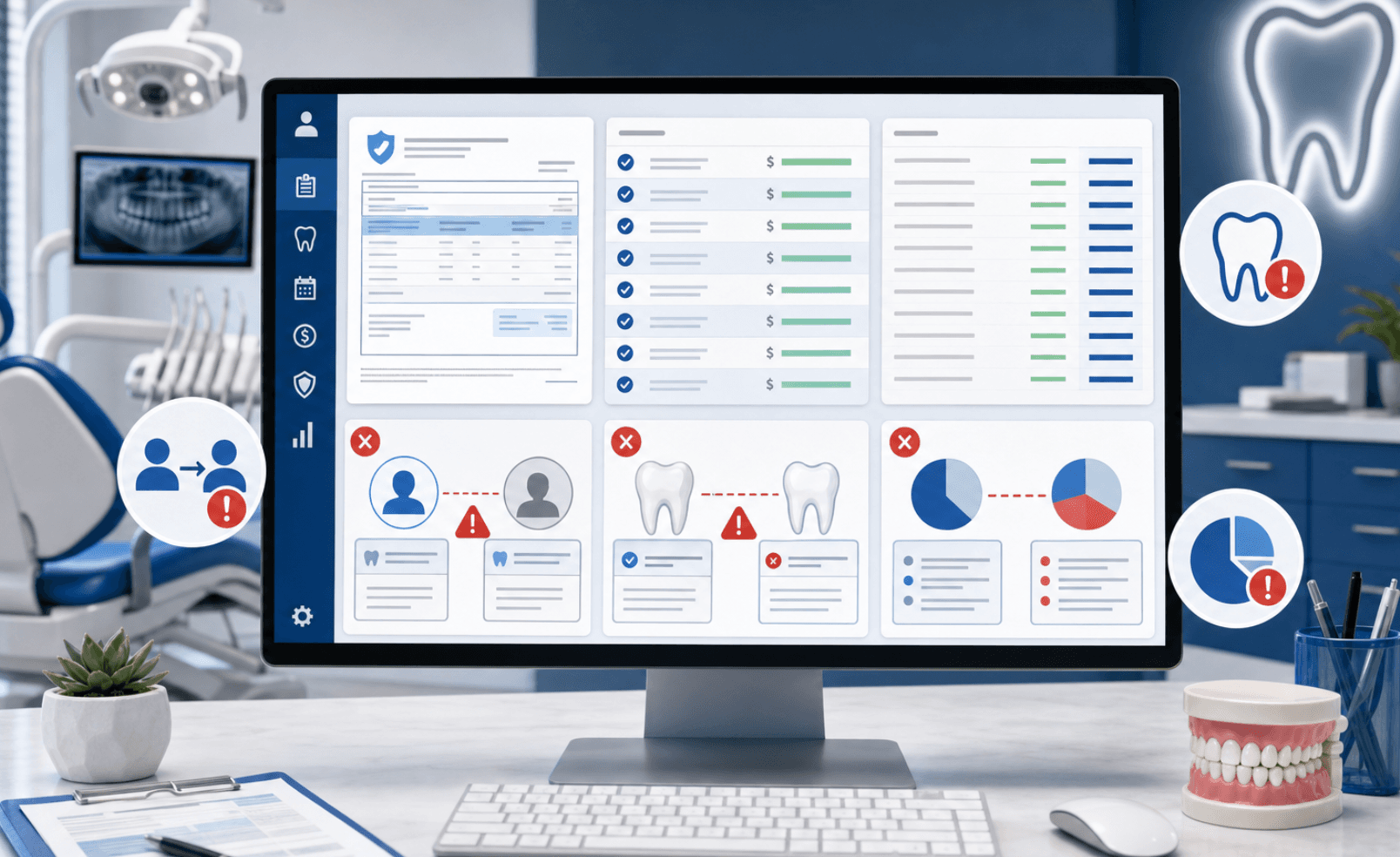
A transposed digit in dental insurance payment posting turns a $1,247 payment into $1,427, hiding a $180 underpayment inside a claim that reads as fully paid. Manual workflows create these gaps all day:
- EOB adjustments coded as patient responsibility instead of contractual write-offs
- Payments landed on the wrong claim when two patients share a last name
- Denials are sitting unnoticed because the reason code was missed
By the time you spot the pattern, the filing deadline has passed. AI reads every EOB line with the same attention, applies posting rules automatically, catches math errors to the cent, and surfaces downcoding or underpayments the moment they hit your system.
TLDR:
- Posting errors hit 55% of dental claims and cost $117 per rework on average.
- Manual entry mistakes hide underpayments, mispost adjustments, and bury denials past filing deadlines.
- AI posting reads EOBs, matches claims, and applies your rules with full audit trails.
- Same-day bank reconciliation flags variances before they disappear into aging reports.
- Lassie automates posting to Dentrix, Eaglesoft, and Open Dental, reclaiming significant staff hours spent on manual payment matching each month.
What Is Dental Insurance Payment Posting and Why Does It Matter
Dental insurance payment posting is the process of recording what a payer sends back after a claim, the payment plus the EOB, accurately inside the practice management system. Each line item gets matched to the right patient, procedure, and ledger entry. Adjustments are applied, write-offs noted, and patient balances calculated.
It sounds clerical. It isn't.
Posting sits at the center of the revenue cycle. A few things hinge on its quality:
- Cash flow visibility, since unposted payments distort what you've collected
- AR accuracy, because aging buckets only mean something if the posting is current
- Patient trust, when statements reflect the real balance owed
- Audit readiness, with EOBs tied to the claims they paid
The True Cost of Payment Posting Errors in Dental Practices
Posting errors rarely show up as a single line on a P&L. They surface as slow collections, aging AR, and write-offs nobody can fully explain.
The scale is bigger than most practices assume. Dental billing errors affect a large share of claims industry-wide, and reworking each denied claim carries a real cost once you count staff time and payment delays.
Where the money actually leaks:
- Misposted adjustments that quietly inflate patient balances or shrink them below what's owed
- Denials are sitting in AR because the original posting hid the reason code
- Duplicate postings that trigger refund requests months later
- Aging buckets that look fine because payments were applied to the wrong claim
A practice running a few thousand claims a year can absorb meaningful revenue losses from errors filed under "AR problems" and never traced back to posting issues.
Common Payment Posting Errors That Cost Practices Money
Posting errors cluster into a handful of recurring patterns, often by the same staffer working through the same backlog.
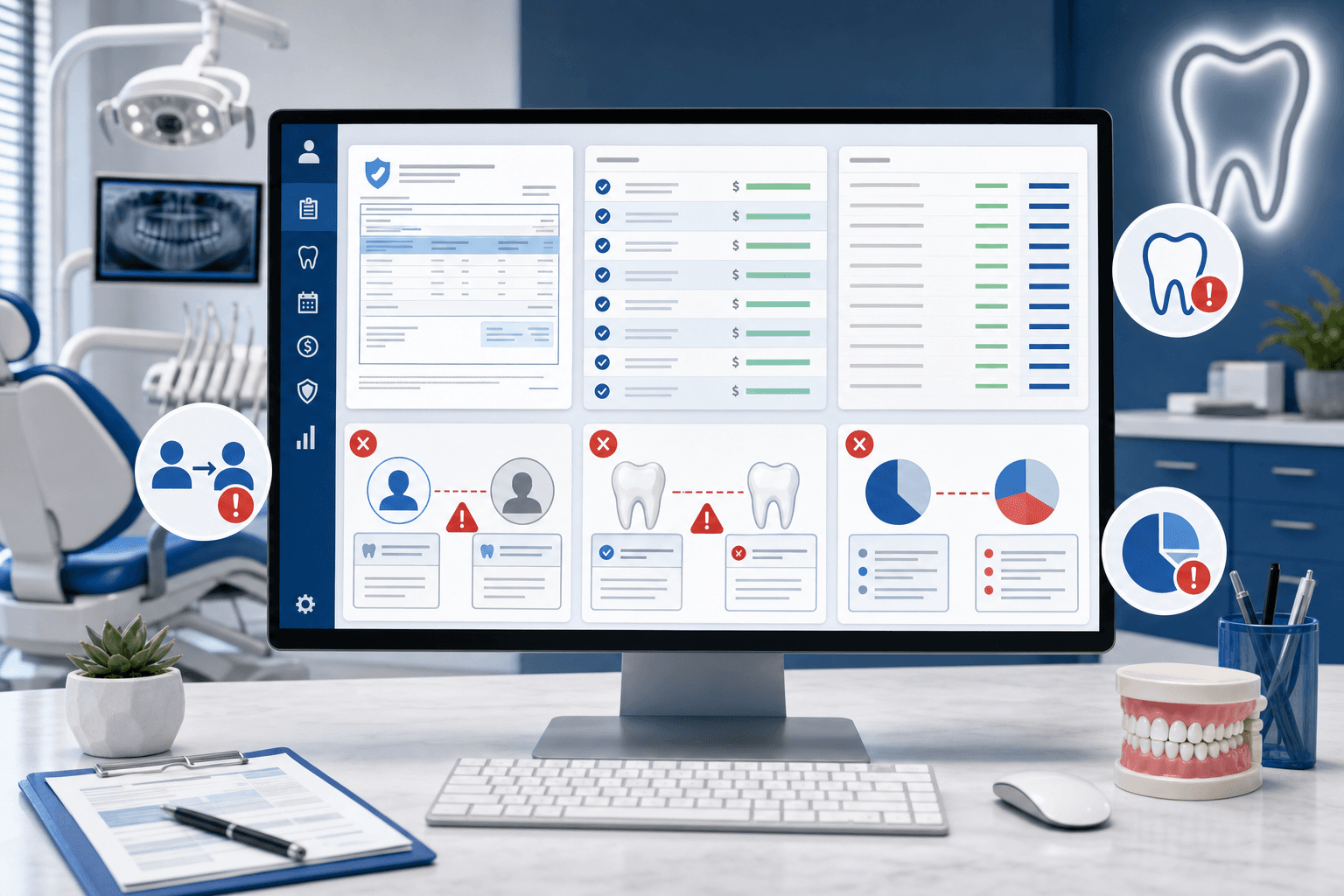
- Payments are applied to the wrong patient account when two patients share a last name or a family shares one policy
- EOB line items matched to the wrong claim, so a paid procedure looks like it was never billed
- Adjustments entered as write-offs when they should have been contractual
- Payments posted to the wrong procedure code or date of service
- Denials buried in the ledger past the filing deadline
- Secondary insurance balances dropped prematurely for the patient
Each ripples downstream into statement errors, patient calls, refund requests, and collections hits.
Misreading EOB Documents and Adjustment Codes
EOBs read like spreadsheets with their own dialect, and small misreads compound fast.
- Submitted amount is what you billed. Allowed amount is what the payer agreed to pay under the contract. Posting the gap as patient responsibility instead of a contractual write-off is a frequent error.
- CARCs and RARCs explain why a line was reduced. Treating a CO-45 like a PR code moves the balance to the wrong party.
- Downcoding (paying a D2740 as a D2750) looks like an underpayment, but is a denial worth appealing?
- Bundling collapses procedures into a single line, leaving unbundled codes appearing unpaid.
Manual Data Entry Mistakes and Their Ripple Effects
A transposed digit looks harmless until it isn't. A $1,247 payment entered as $1,427 hides a $180 underpayment; no aging report will surface, because the claim reads as fully paid.
By hour three of an EOB stack, attention drifts:
- Procedure codes mistyped (D2740 as D2750), masking downcoding
- Claim numbers fat-fingered, landing payments on stale claims
- Dates off by a day, breaking the reconciliation
- Decimals shifted, turning $34.20 into $342.00
With hundreds of subtly wrong entries, no one can spot that a payer consistently downcodes crowns. The pattern hides in the data.
Delayed Payment Posting and Cash Flow Disruption
When EOBs sit unposted for a week, the ledger lies. AR balloons with claims already paid, forecasts overstate what's outstanding, and patient statements wait on balances that can't be calculated yet.
The downstream effects:
- Patient billing gets pushed back, widening the gap between service and payment
- Slow-paying carriers blend into the backlog, hiding which payers are behind
- Denial patterns stay invisible until filing deadlines pass
- Daily deposits stop tying out to PMS totals, breaking reconciliation
Same-day or next-day posting keeps AR accurate and surfaces problems while they're still fixable.
How AI Automates Payment Posting Workflows
AI posting collapses manual steps into one pass. The system pulls EOBs from payer portals, reads them, matches each line to the right claim in the PMS, applies posting rules, and writes entries to the ledger. Ambiguous cases route for human review instead of posting on a guess.
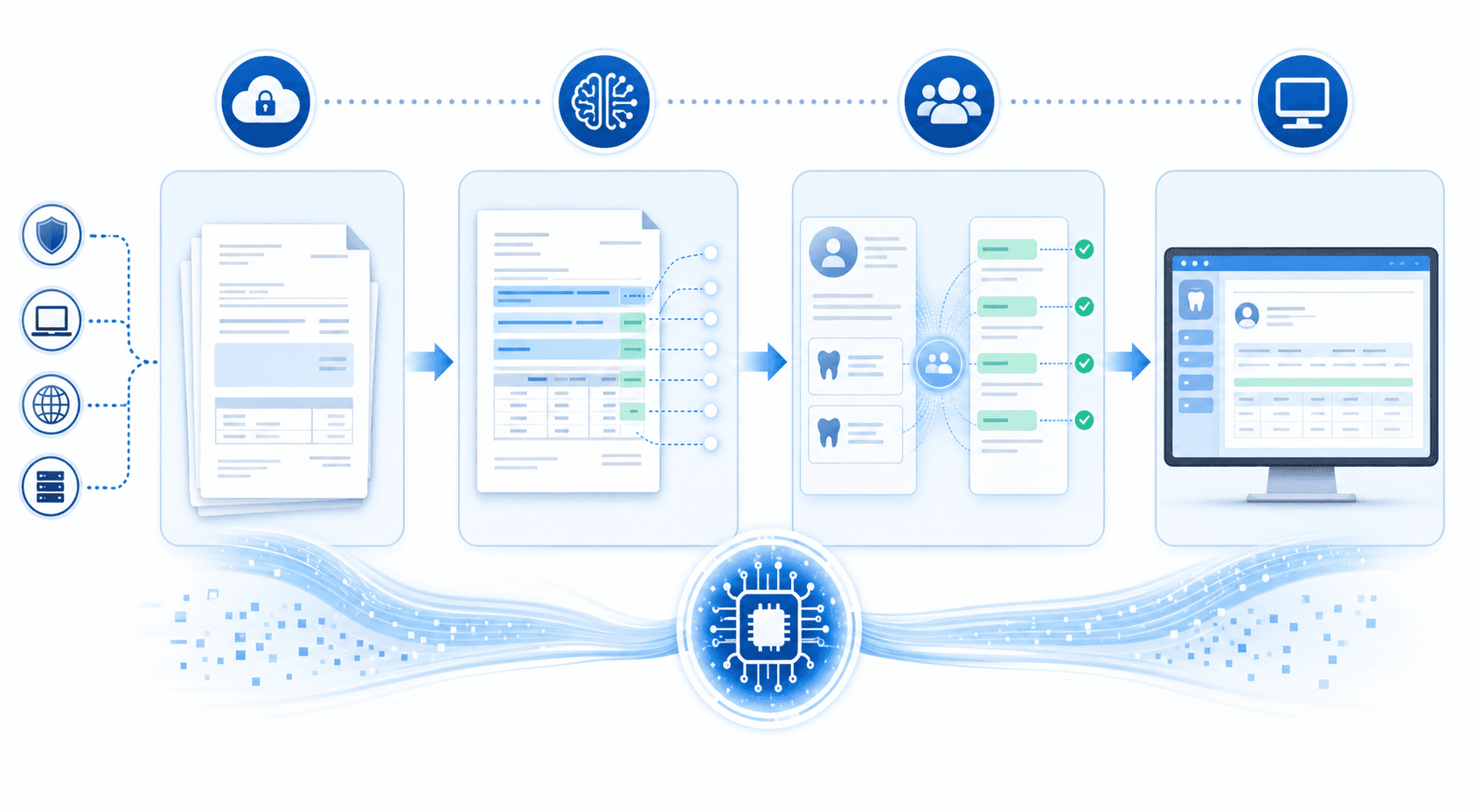
The mechanics, in order:
- Retrieval of EOBs and EFTs from payer portals and clearinghouses
- Extraction of payment amounts, CARCs, RARCs, and adjustments
- Matching to open claims by patient, procedure, and date
- Application of practice-specific posting and adjustment rules
- Flagging of mismatches, underpayments, and denials
AI-powered dental software reduces claim denials by catching patterns before they post.
AI Accuracy Advantages Over Manual Posting
Software reads every EOB line with the same attention at 7 am and 7 pm. No fatigue, no decimal drift, no transposed claim numbers.
Concrete accuracy gains over manual posting:
- Math checks on every line, so a $1,247 payment never lands as $1,427
- Consistent rule application across thousands of claims, so contractual write-offs never get miscoded as patient balances
- Pattern recognition that catches a payer downcoding D2740 to D2750 across multiple claims
- Full audit trails tying each posted entry to the source EOB, adjustment code, and rule applied
Real-time Bank Reconciliation and Payment Matching
Three numbers should tie out daily: payer remittance, bank deposit, and PMS posting. Manual workflows only catch gaps at month-end, if at all. By then, the EOB explaining the shortfall may be weeks old, the payer contact may have changed, and the filing window may be gone.
Real-time reconciliation closes that loop as it happens:
- EFT deposits match the source EOBs by payer, date, and amount
- A $4,820 deposit against $4,910 in EOB totals flags a $90 variance on the same day
- Missing EOBs for posted deposits surface before the trail goes cold
- Bank and PMS totals tie out daily, no frantic month-end scramble
- Split deposits (one EFT covering multiple payers) are broken out per EOB, so each payer's remittance posts to the right bucket
What reconciliation actually catches goes beyond math. A deposit that matches the EOB total but contains a short-paid line item still fails the line-level check. A carrier that consistently deposits 2 days after the EOB date is flagged as a timing pattern, not a missing payment. Practices that run manual reconciliation often discover these gaps only when a patient calls about a balance that should have been zeroed out months ago.
When a variance surfaces, the system attaches the source EOB, the EFT reference, and the payer contact, so whoever investigates has everything in one place instead of hunting across portals. Variances stop hiding in aging reports.
Customizable Posting Rules and Adjustment Logic
Good AI posting bends to your workflow. Rules get configured during onboarding and apply automatically thereafter.
| Rule type | What you configure |
| Contracted rates | Auto-adjust gaps between billed and allowed amounts per payer fee schedule |
| Write-offs | Threshold-based write-offs for out-of-network balances under a set amount |
| Denial handling | Per-code logic for what auto-posts versus what routes to manual review |
| Procedure-specific | Age limits on fluoride, downgrade routing for crowns, and deductible preservation |
| Posting date | Match by date of service, EOB issue, or bank deposit |
When actual allowables don't match the PMS fee schedule, posting halts for review instead of writing through a mismatch. The same logic catches overpayments above contracted rates, codifying your policies instead of asking staff to learn a new methodology.
Denial Flagging and Appeals Workflow Integration
Posting and denial management should be part of the same workflow. When a CARC like CO-45 or a downcoded D2740 hits the EOB, the system tags it at posting and pushes it into an appeals queue with submitted amount, allowed amount, and reason code attached.
What that queue shows:
- Submitted vs. allowed vs. paid, line by line, with the CARC or RARC explaining the gap
- Downcoding is flagged separately from denials, since appeal paths differ
- Patterns surfaced across payers, so repeated downcoding stops reading as one-off
- Filing deadlines tracked per payer
Staff resubmits with context already organized.
Lassie: AI-Native Payment Posting That Eliminates Manual Work
We built Lassie as AI-native posting software for Dentrix, Eaglesoft, and Open Dental. EOBs are retrieved, read, and posted directly into the PMS, with granular rules configured during onboarding to codify write-off logic, adjustment allocations, and denial handling, ensuring they are applied consistently.
Practices on Lassie see four to seven percent more revenue per month, offsetting the two percent posting fee while reclaiming the staff hours spent on manual payment matching each month. Real-time bank reconciliation, error catching to the cent, and centralized EOB storage come standard.
Final Thoughts on Cleaning Up Your Payment Posting
Posting sits between what payers send and what your ledger shows, and that gap costs more than most practices track. Manual workflows bury the patterns: the payer downcoding every crown, the adjuster miscoding write-offs, the EOBs sitting unposted while AR balloons with ghost receivables. When posting runs clean, your AR reflects reality, and your billing team stops firefighting problems that started two weeks earlier in a stack of paper remittances. See how Lassie handles it end-to-end, book a demo.
FAQ
Can I build dental payment posting automation without replacing my entire billing workflow?
Yes. AI posting software like Lassie automates only the EOB retrieval and posting layer while leaving claim submission, verification, and appeals under your control. You keep your existing PMS and staff workflows but eliminate the manual hours spent matching EOBs to claims and verifying bank deposits each month.
What's the difference between AI posting software and tech-powered billing agencies?
AI posting software like Lassie uses code to read EOBs and write entries into your PMS with zero humans doing the posting work across Dentrix, Eaglesoft, and Open Dental. Tech-powered billing agencies like eAssist and DayDream still rely on human billers to perform the actual posting, with dashboards layered on top; they're staffing companies shipping software, not software replacing staffing.
How long does it take for posting errors to actually hit cash flow?
Same-day impact. When a $1,247 payment gets entered as $1,427, your AR report immediately undercounts what's owed by $180. Patient statements wait on balances that can't be calculated yet, denials sit past filing deadlines because the CARC was buried in the ledger, and bank reconciliation breaks the moment your PMS totals stop matching deposits. The longer EOBs sit unposted, the wider the gap between what your reports show and what's real.
What happens to my posted data if I cancel an AI posting service?
You retain full access to all posted EOB data. Platforms like Lassie provide bulk downloads of all EOBs as searchable PDFs organized by patient name and date of service, with storage maintained for seven years. Your PMS already contains all posted payment entries, adjustments, and ledger activity, so canceling the service doesn't erase historical posting work or create compliance gaps.
AI posting software vs full-service billing agency: which one actually saves money?
AI posting software costs around 2% of posted collections and automates only payment posting and reconciliation, so you still need staff for claim submission and follow-up. Full-service agencies like eAssist charge 2.5-3% but handle end-to-end workflows including submission, posting, patient billing, and AR follow-ups. Practices switching to AI posting see 4-7% more revenue per month from fewer missed adjustments and denials, which offsets the software fee while reclaiming manual posting hours. But you're trading an all-in-one service for a hybrid model where software handles posting, and your team handles everything else.