Dental Virtual Assistant: The Real Story (July 2026)
Dental VA jobs in July 2026: human remote workers vs AI-powered admin support. Salary data, HIPAA compliance, insurance posting, and implementation tips.
Max Shore - July 29, 2026
Your recall list is three months behind, insurance verifications are piling up, and the idea of hiring help without adding another body to the break room sounds perfect until you start digging into what "dental virtual assistant" actually means in 2026.
Some listings talk about dental virtual assistant jobs remote with humans overseas doing billing, others describe virtual dentist jobs or virtual dental assistant jobs that are really just AI bots picking up the phone, and the salary ranges for dental VA jobs salary, dental virtual assistant salary, va dental assistant salary, and hello rache dental virtual assistant salary are so wide you can't tell if you're comparing apples to apples. You've seen posts about dental virtual assistant jobs from home, part-time dental virtual assistant gigs, virtual dental assistant jobs work from home, dental VA jobs near me, va dental assistant jobs near me, and even remote dental virtual assistant services that claim to do it all, but nobody's breaking down what a virtual assistant dental hire actually logs into your system to do versus what a virtual dental receptionist or AI dental receptionist UK tool handles on its own.
We're walking through the two completely different things hiding under the same label, what dental virtual assistant job descriptions cover in practice, how HIPAA and PMS access work when your biller is halfway around the world, and where the models break down so you can decide what fits before you sign a contract or post a dental virtual assistant hiring ad that attracts the wrong kind of help.
TLDR:
- Dental virtual assistants are human remote workers handling admin inside your PMS. AI receptionists (patient-facing calls and scheduling) and AI RCM tools (back-office insurance posting) are separate categories, not dental VAs.
- Insurance posting costs practices $100K to $200K annually in manual admin work, totaling 80 to 100 hours a month.
- You need a signed BAA, encrypted PHI channels, and documented HIPAA training for every VA or AI vendor with PMS access.
- Back-office AI EOB posting is prime for automation: structured data, no patient interaction, and AI runs faster, more securely, and more accurately than a human VA, and is usually cheaper once you factor in errors, training, and oversight.
- Lassie automates back-office insurance work end to end, where other platforms still route tasks to human billers.
What Is a Dental Virtual Assistant?
A dental virtual assistant is a human remote worker who handles administrative work for a practice without sitting in the office. The term gets stretched to cover AI tools too, but that conflation creates real confusion when you're trying to decide what to hire or buy.
Human VAs, often based in the Philippines or Latin America, log into your practice management system to schedule appointments, verify insurance, post payments, and chase claims. They are people doing a job remotely, not software.
AI receptionists and AI RCM tools are two separate categories that get lumped in under the same umbrella. AI receptionists answer phones, book appointments, and send reminders without a person in the loop: patient-facing work with its own complexity and risk. AI RCM tools handle back-office insurance posting: retrieving EOBs, reading line items, and writing payments into the PMS. These categories have different risk profiles, different use cases, and nothing to do with dental VA jobs.
Dental Virtual Assistant Roles and Responsibilities
Dental VAs typically split their work into four buckets, with overlap depending on practice size and staffing gaps.
- Front desk operations: booking and rescheduling appointments, confirming visits, managing recall lists, and triaging inbound calls or web form requests.
- Insurance coordination: verifying eligibility, breaking down patient benefits, submitting claims, and following up on aging or denied claims.
- Back office billing: posting EOBs into Dentrix, Eaglesoft, or Open Dental, matching payments against deposits, and generating patient statements.
- Patient communication: sending reminders, answering billing questions, coordinating treatment financing, and chasing no-shows.
- Records management: updating charts, attaching X-rays to claims, and keeping documentation audit-ready.
Dental Virtual Assistant Salary and Job Market Outlook
Pay scales depend heavily on whether you hire domestically or offshore, and the gap is wide.
US-based virtual dental assistants earn an average of $24.40 per hour, according to ZipRecruiter, with treatment coordinators and insurance specialists earning higher rates. Direct hires from the Philippines or Latin America run $1,200 to $2,000 per month fully loaded, often under a quarter of a stateside front desk hire.
Remote VA listings, including no-experience roles, have grown sharply on Indeed, OnlineJobs.ph, and agencies like MedVa, Hello Rache, and Wisdom Dental Billing. California, Texas, and Florida lead hiring.
Human Virtual Assistants vs AI Dental Receptionists
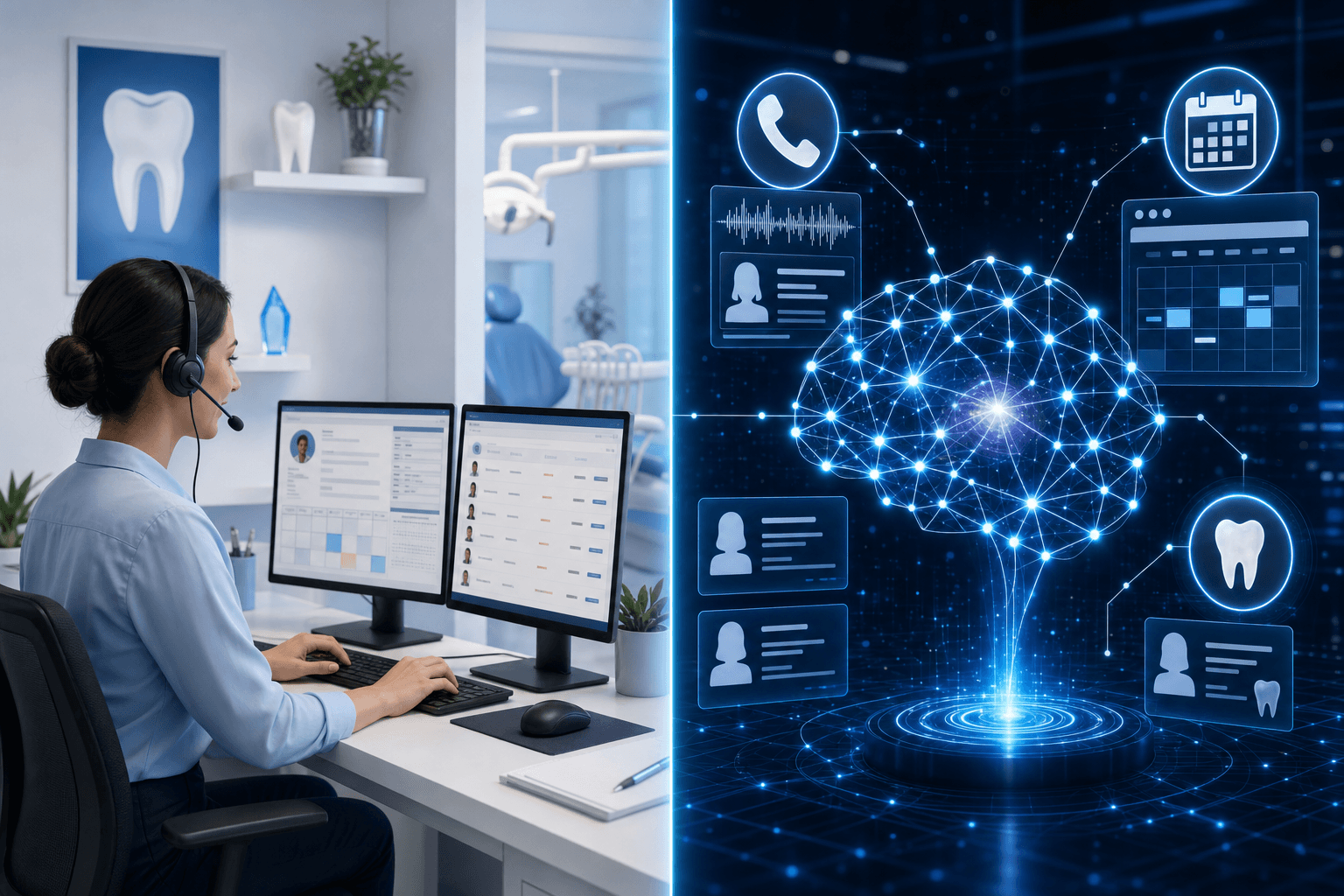
These are three distinct categories, not two. Human VAs are remote labor with a login. AI receptionists are software that handles patient-facing work: picking up the phone, booking the slot, sending the reminder. AI RCM tools are a third bucket: back-office software that retrieves EOBs, maps CDT codes, and posts payments into your PMS with no human in the loop.
Patient-facing automation carries more risk: edge cases, complex conversations, and patient trust are harder for software to handle without gaps. Back-office automation is the opposite: structured data, rule-based logic, no patient interaction, and clear right-or-wrong outcomes make it prime for full automation. AI RCM runs faster than a human VA, is more secure (no person touching deposit data), more accurate (no manual entry errors), and usually cheaper once you factor in training, QA, and the cost of posting mistakes.
| Dimension | Human VA | AI Receptionist | AI RCM (Back Office) |
| Hours covered | Shift-based, time-zone bound | 24/7, no queue | 24/7, no queue |
| Pricing | Hourly or monthly salary | Per-call or flat subscription | Usage-based, only on posted payments |
| Onboarding | Training, SOPs, QA | Workflow config, prompt tuning | Posting rules configured during onboarding |
| Failure mode | Sick days, turnover, typos | Edge cases, escalation gaps | Ambiguous cases flagged for staff review |
| Best fit | Multi-task admin, billing, AR | High call volume, after-hours | Insurance posting, bank reconciliation |
| Patient-facing risk | Moderate (human judgment) | Higher (complex conversations, patient trust) | None (no patient interaction, structured data) |
Solo practices often pair an AI receptionist for phones with a part-time VA for billing, or replace the billing VA with AI RCM software for the back office. Group practices blend all three: AI handles patient intake and reminders, VAs cover admin tasks that require human judgment, and AI RCM handles insurance posting end to end.
HIPAA Compliance Considerations for Virtual Dental Staff
HIPAA does not ban offshore or remote help, but it puts the burden on you to protect PHI when a third party touches it. The California Dental Association urges practices to proceed carefully before granting outside access.
Three obligations matter most:
- Signed Business Associate Agreement with every VA, agency, or AI vendor handling patient data, covering breach notification and subcontractor terms.
- Encrypted channels for PHI: no SMS, no personal Gmail, no unsecured file shares. VPN access, audit logs, and role-based permissions are table stakes.
- Documented HIPAA training with annual refreshers, proof of completion stored alongside the BAA.
Offshore hires add a wrinkle. US enforcement against foreign workers is limited, so contract terms and technical controls carry most of the weight.
Cost Comparison: Virtual Assistants vs In-House Dental Staff
In-house admin staff costs more than salary. Front desk, billing, and office manager roles typically run 5 to 8 percent of collections, and total labor averages 27 percent of overhead per Dental CPAs once you fold in payroll taxes, premiums, PTO, and workspace.
A $52,000 hire lands closer to $68,000 fully loaded. Two of those, plus a biller, hit $200,000 before software.
Virtual options shift the math:
- Offshore VA: $1,200 to $2,000 monthly, no benefits or payroll tax.
- US-based remote VA: $24 per hour plus agency markup.
- AI receptionist: flat subscription, no headcount creep.
VAs cut direct labor, but QA, turnover, and supervision hours still cost you.
Key Features of AI Dental Receptionist Solutions
AI dental receptionists now ship a fairly standard feature set. Here's what to look for when comparing vendors.
- 24/7 voice AI handling new patient intake, FAQs, and overflow during peak hours
- Scheduling that writes directly into Dentrix, Eaglesoft, or Open Dental and respects provider templates
- Automated SMS, email, and voice reminders with two-way confirmation and waitlist fill on cancellations
- Insurance eligibility checks at booking, pulling benefits, and remaining maximums from payer portals
- Emergency triage that scores urgency and routes after-hours calls to the on-call clinician
- Multi-channel coverage across phone, SMS, web chat, and Google Business Profile with a unified log
How Dental Practices Actually Use Virtual Administrative Support
Most practices ease into virtual support instead of swapping out staff overnight. A common pattern looks like this:
- Start with one workflow (insurance verification or recall calls) for 30 days before adding billing or AR.
- Split duties clearly: in-office staff own patient-facing moments, VAs own queue work inside the PMS.
- Provision named PMS logins with role-based permissions, MFA, and session recording. Never share credentials.
- Run daily standups, weekly QA audits on posted claims, and monthly KPI reviews on no-show rate, AR days, and clean-claim percentage.
Limitations and Trade-Offs of Virtual Dental Admin Models
Virtual models leave specific gaps: scope limits on end-to-end claims work, secondary insurance edge cases, and denial appeals that still need a human writer. Know these before you sign anything.
- Scope ceiling: human VAs post payments or handle phones but rarely cover end-to-end claims submission, aging follow-up, and appeals under one roof. AI receptionists stop at scheduling and intake, patient-facing work that is harder to automate fully. AI RCM tools cover back-office posting well but do not submit claims or contact payers on aging balances.
- Secondary insurance and coordination of benefits often fall back to in-office staff, especially outside Open Dental.
- Denial appeals still need a human writer with a clinical context. AI flags; people argue.
- Staff anxiety is real. Office managers hear "automation" and assume layoffs, stalling rollout.
- Two dashboards, two logins, two notification streams. Tool sprawl is its own tax.
- Edge cases (Medicaid TPAs, unusual EOB formats, paper-only carriers) break automation and leak back to your team.
Solo offices with one strong admin sometimes move faster in-house than coordinating with a remote partner across time zones.
How AI-Powered EOB Posting and Insurance Reconciliation Works in Dental Practices
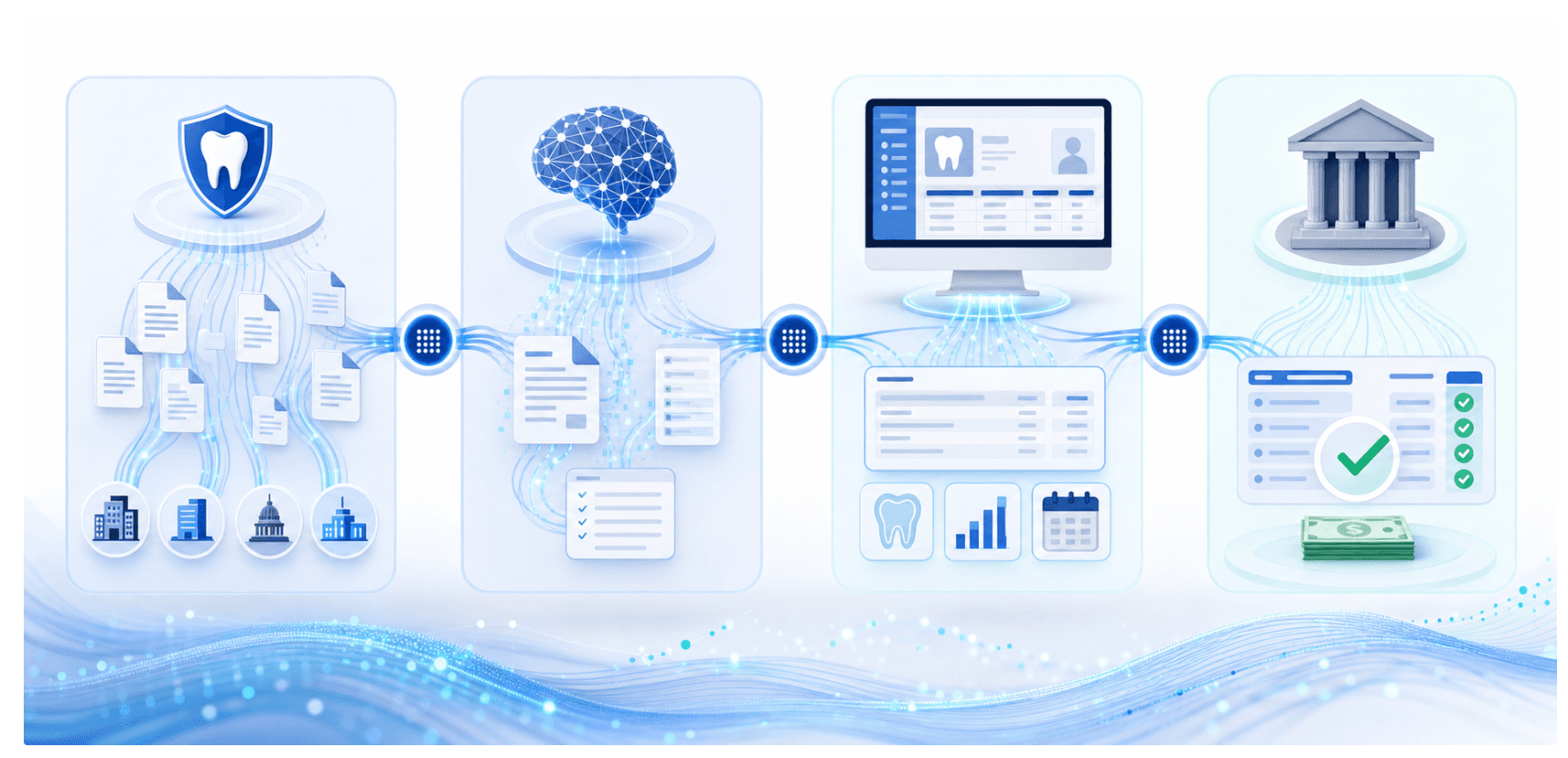
Insurance posting is the biggest time sink in the back office. A typical practice spends 80 to 100 hours a month manually matching payments, which amounts to $100K to $200K a year in admin overhead. AI rewrites the labor model behind that work through four stages:
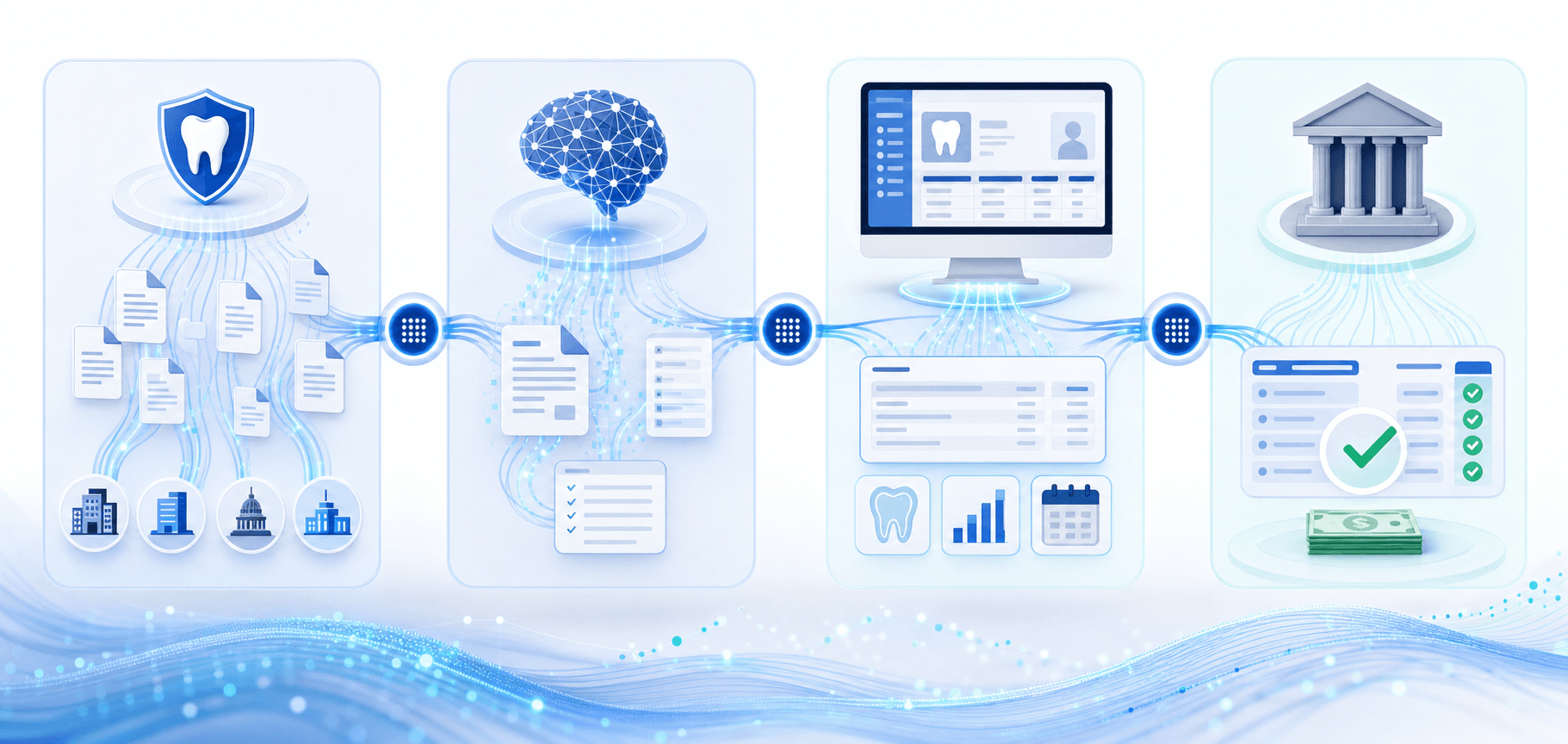
- Retrieval: bots log into payer portals, clear MFA, and pull EOBs as released. ERA feeds are ingested in parallel.
- Parsing: line items get read, CDT codes mapped, adjustments and patient responsibility identified, EOBs matched to claims.
- Posting: payments are written into Dentrix, Eaglesoft, or Open Dental, with a rules engine handling write-offs and fee-schedule mismatches.
- Reconciliation: payments tied to bank deposits in real time, with ambiguous cases routed to staff.
Lassie: AI-Native Insurance Revenue Cycle Automation for Dental Practices
Most of this article covers VAs and AI receptionists handling the front of the practice. Lassie sits on the other side: the insurance back office, where claims, EOBs, and bank deposits pile up.
We automate EOB posting and payment matching across Dentrix, Eaglesoft, and Open Dental, without human intervention. The system pulls EOBs from payer portals, reads each line, and writes payments to the PMS in accordance with rules set during onboarding. Bank deposits sync in real time.
Practices on Lassie see 4 to 7 percent more revenue per month after implementation, covering the 2 percent posting fee.
The product also handles SMS patient billing, secondary claim filing through Open Dental Exchange, and AI-drafted appeals for denied claims. Where eAssist, Zentist, and Teero rely on human billers, Lassie runs the workflow end-to-end in software.
Final Thoughts on Dental Virtual Assistants and AI Tools
The confusion around dental virtual assistants clears up once you separate remote workers from software. Human VAs log in and do the work. AI tools run the workflow without clocking in. Your practice probably needs elements of both, just not at the same time or for the same jobs. If you want to see how Lassie handles the insurance back office, book a demo.
FAQ
Can I hire a dental virtual assistant with no experience in the field?
Yes. Entry-level dental virtual assistant jobs exist, particularly through offshore agencies like MedVa and Hello Rache, where training is built into the onboarding process. Expect closer supervision during the first 60 to 90 days while the VA learns your PMS, posting rules, and insurance carrier quirks.
Dental virtual assistant vs AI receptionist: which one should I start with?
If your bottleneck is phones and appointment scheduling, start with an AI receptionist to cover after-hours and overflow. If your problem is insurance posting, claims follow-up, or AR backlogs, hire a human VA or switch to software like Lassie that automates EOB posting entirely.
What's the actual cost difference between a VA and an in-house billing staff?
A full-time US-based front desk hire costs around $68,000, including payroll taxes, benefits, and workspace. An offshore VA runs $1,200 to $2,000 per month with no benefits or payroll tax, cutting direct labor by roughly 70 to 80 percent before you account for supervision and QA time.
How do virtual dental assistant jobs work from home without violating HIPAA?
Remote VAs access your practice management system through encrypted VPN connections with role-based permissions, session logs, and signed Business Associate Agreements covering breach notification and subcontractor terms. US enforcement against offshore workers is limited, so contract terms and technical controls carry most of the compliance weight.
Do AI dental receptionists actually post insurance payments, or are they just answering phones?
Most AI receptionists stop at scheduling, reminders, and intake. They don't post EOBs or match deposits. Lassie is different: it retrieves EOBs from payer portals, reads every line item, and writes payments into Dentrix, Eaglesoft, or Open Dental against custom posting rules, with bank payment matching happening in real time and no human biller in the loop.